Why Ad Platform Conversions Don't Match Sales Data (and How to Reconcile)
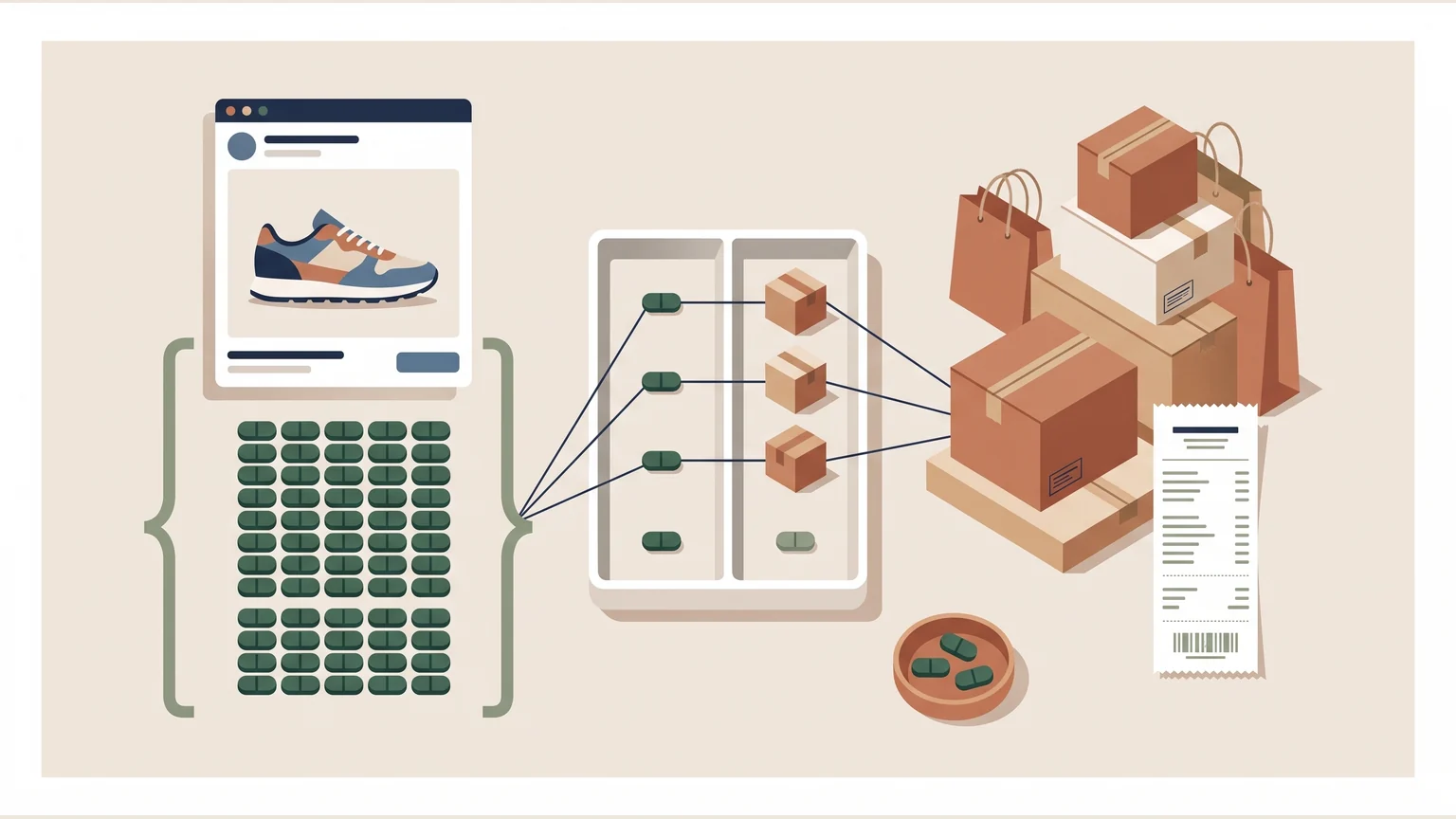
Ad platform and sales counts differ because each observes a different moment, unit and attribution window, so neither is necessarily broken. A fictional example with 20 attributed conversions against 15 confirmed orders reconciles them and shows which number answers which question.
A campaign may report twenty conversions while the commercial system records fifteen sales. That difference alone does not prove either source is broken. Each observes a different moment and answers a different question: the platform estimates the actions it can credit to itself; the business records what happened in the sale.
Working with advertising and sales data taught me to begin with that distinction. Before building a rate or a dashboard, I write down what each number represents: unit of analysis, date, attribution window, exclusions and source. This article uses an entirely fictional example. It does not reproduce any client’s data, screens or rules.
Two measurement lanes
Suppose that, over one week, a platform reports 20 attributed conversions. The sales system holds 15 confirmed orders, 12 of which preserve enough information to link them to the campaign.
| Reading | Fictional value | Question answered |
|---|---|---|
| Platform-attributed conversions | 20 | How many actions does the platform credit under its rules? |
| Business-confirmed orders | 15 | How many sales were recorded? |
| Orders with a verifiable campaign link | 12 | How many orders can be connected to this campaign with available data? |
Subtracting 15 from 20 does not measure “lost conversions.” A person may interact with several ads before buying; the platform may count an action the business does not consider a sale; an order may arrive after the reporting cutoff; and three of the fifteen orders lack a verifiable link. Even when both sources use the word conversion, their definitions are not interchangeable.
What to check before drawing a conclusion
I would first compare complete periods in the same time zone. Then I would inspect which action the platform counts, how long its attribution window lasts, and which order states the commercial system includes. Finally I would measure link coverage: 12 of 15 orders, or 80%, in this fictional week. That figure does not say the other 20% came from a different channel; it says their origin cannot be verified with the available data.
The useful practice is to preserve both lanes. The platform supports campaign decisions inside its own framework; the commercial record supports sales analysis. Reconciliation shows where they meet and where a question remains open. If coverage suddenly falls, the first decision is to investigate measurement, not move spend.
This case connects to my insurance data platform, where a number must also be traceable to its source, and to APIs for analysts, which explores what can fail before a number reaches a report.